 by
by Maruti Suzuki e Vitara : For years, the one question hanging over India’s biggest car brand was simple: when will Maruti Suzuki actually launch an electric car? In February 2026, that wait finally ended with the e Vitara, and the response has been loud. It’s not the flashiest EV on Indian roads, it doesn’t chase the futuristic design language that rivals like the Tata Curvv EV or Hyundai Creta Electric lean into, but it brings something far more valuable to the table: the trust of India’s largest car brand, the country’s biggest service network, and a genuinely clever pricing model that brings EV ownership within reach of buyers who were previously priced out entirely.
In this review we’ll cover everything that matters before you book one: design, cabin space, battery and range, real-world driving experience, charging, safety, the unusual Battery-as-a-Service pricing model, genuine owner feedback, and how it stacks up against the EVs everyone is currently cross-shopping it against.
Maruti Suzuki e Vitara 2026 Overview and Quick Specifications
| Parameter | Details |
|---|---|
| Segment | Mid-size Electric SUV |
| Price Range (Ex-showroom, outright) | ₹15.99 Lakh – ₹19.99 Lakh |
| Price Range (BaaS, battery rental) | ₹10.99 Lakh + ₹3.99/km battery fee |
| Battery Options | 49 kWh, 61 kWh |
| Power Output | 142–144 bhp (49kWh) / 174 bhp (61kWh) |
| Torque | 193 Nm |
| Claimed Range (ARAI) | 440 km – 543 km |
| Real-World Range | 420–450 km (61kWh variant) |
| Drive Type | Front-Wheel Drive (single motor) |
| Charging (DC Fast) | 10–80% in approximately 45 minutes |
| Charging (7.4kW AC Home) | 6.5–10 hours, 10–100% |
| Safety Rating | 5-Star Bharat NCAP, 4-Star Euro NCAP |
| Variants | Delta, Zeta, Alpha |
| Battery Warranty | 8 years / 1,60,000 km |
This table covers the essentials most buyers search for first. Now let’s unpack why the e Vitara has become such a significant moment for the Indian EV market.
Why Maruti Suzuki e Vitara Is Trending in India’s EV Market
The e Vitara matters because of who’s building it, not just what it offers. Maruti Suzuki has historically played it safe with hybrids and CNG rather than rushing into full electrification, so its first ground-up “born-electric” SUV, built on a dedicated skateboard platform rather than a converted ICE chassis, was always going to draw outsized attention. The brand’s reputation for reliability and its 1,500-plus EV-ready service network address the single biggest fear most Indian buyers have about going electric: what happens when something goes wrong and the nearest service centre is two hours away.
The real headline-grabber, though, is the pricing innovation. With the Battery-as-a-Service model, buyers can get into an e Vitara for just ₹10.99 lakh, paying a per-kilometre rental for the battery instead of the full upfront cost. That single move has made the e Vitara the most accessible long-range electric SUV in India, undercutting rivals that demand the full battery cost on day one. Add a segment-leading claimed range of up to 543 km, a 5-star Bharat NCAP rating, and the fact that it’s India’s first electric SUV to achieve that score under the Bharat NCAP protocol, and you have a car that’s been generating consistent search interest and showroom footfall since launch.
Maruti Suzuki e Vitara Exterior Design and Styling Highlights
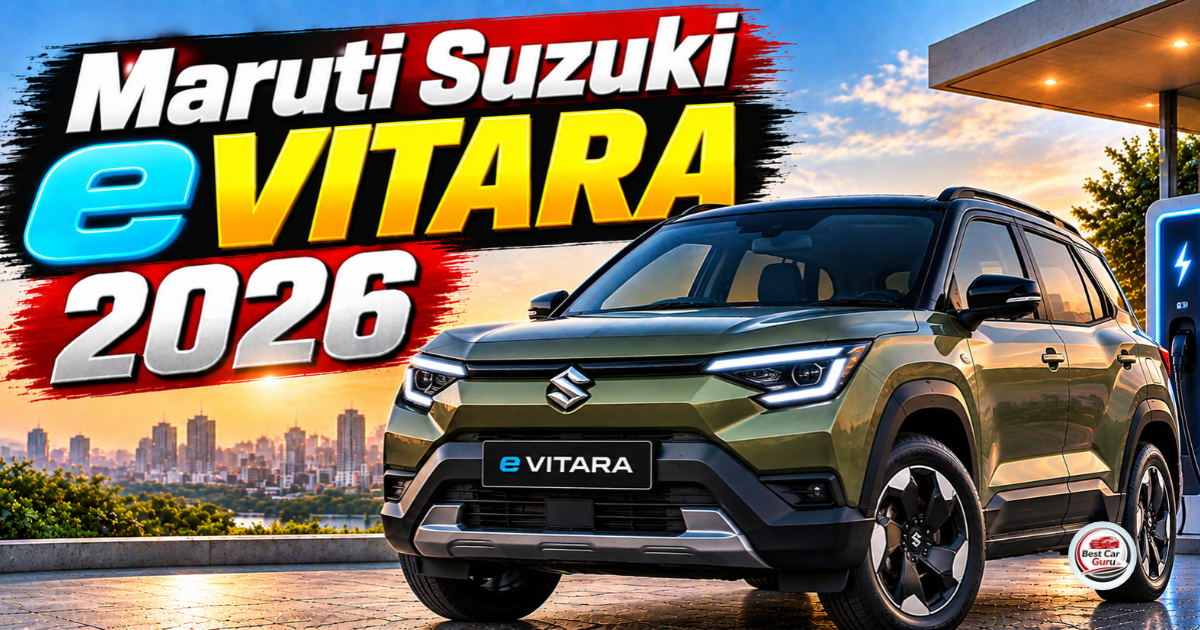
Unlike many EVs that chase an exaggerated, futuristic look, the e Vitara deliberately keeps things approachable. It carries typical SUV proportions rather than a low, swoopy silhouette, a design choice aimed squarely at buyers transitioning from petrol or diesel SUVs who don’t want their first EV to feel alien. Up front, a Y-shaped LED DRL module houses sharp projector headlights, flanked by a closed-off grille with active air flaps for aerodynamic efficiency, and the Suzuki badge sits prominently at the centre.
Side profile details include a muscular stance with flared wheel arches, a high bonnet line, thick cladding, body-coloured ORVMs with integrated turn indicators, and a charging flap discreetly built into the bodywork. Buyers can choose between 18-inch standard alloys or optional 19-inch aero wheels on higher trims. At the rear, split tail lights and a high-mounted stop lamp complete a look that several reviewers describe as “clean” and likely to “age well,” a deliberate departure from EV styling trends that risk feeling dated within a few years.
Maruti Suzuki e Vitara Interior, Cabin Space and Comfort Features
Step inside and the cabin philosophy mirrors the exterior: familiar, functional, and easy to use rather than spectacle-driven. The dashboard uses a clean layout with a 10.25-inch digital instrument display paired with a 10.1-inch infotainment touchscreen, plus physical controls retained for frequently used functions, a deliberate choice that makes the transition from a regular Maruti SUV feel seamless. Interior quality is widely regarded as a genuine step up for the brand, with soft-touch materials used generously across the dashboard and armrests.
Comfort features include electrically adjustable, ventilated front seats, a 10-way powered driver’s seat, sliding and reclining rear seats, a wireless phone charger, and a floating centre console finished with glossy black inserts. A fixed glass panoramic sunroof is offered on the Alpha trim, adding to the airy cabin feel. One consistent criticism from owners, however, is rear-seat headroom, which several reviewers describe as tighter than expected for an SUV of this size, alongside a boot that, while flexible thanks to the sliding rear bench, is smaller than rivals offer. If rear passenger space and cargo capacity are priorities, it’s worth measuring this specifically against your needs during a test drive.
Maruti Suzuki e Vitara Battery, Motor and Performance Specifications
The e Vitara is offered with two battery pack options, both mated to a single front-axle-mounted motor in a front-wheel-drive layout.
| Battery Pack | Motor Power | Torque | Claimed Range (ARAI) | 0-100 km Top Speed |
|---|---|---|---|---|
| 49 kWh | 142–144 bhp | 193 Nm | 440 km | ~160 kmph (approx) |
| 61 kWh | 174 bhp | 193 Nm | 517–543 km | ~160-180 kmph (approx) |
On the road, the first impression is the smooth, silent surge of power typical of EVs, with no waiting for gears to drop or engine revs to build. In city traffic, light steering makes the e Vitara easy to thread through small gaps, and the 174 bhp motor on the 61kWh variant feels genuinely punchy for confident highway overtakes. Reviewers consistently describe the throttle response as dulled down and linear rather than aggressive, which makes the car easy and unintimidating to drive, a deliberate calibration choice that prioritises approachability over outright excitement. Multiple regeneration levels let drivers tailor energy recovery, including a setting close to one-pedal driving for stop-start city traffic. All-wheel drive isn’t available at launch, though Maruti has hinted at a future expansion that could appeal to more adventure-oriented buyers down the line.
Maruti Suzuki e Vitara Range, Charging and Real-World Efficiency
Maruti’s ARAI-claimed range tops out at 543 km on the larger 61kWh pack, placing it among the longest-range EVs in its segment on paper. Independent testing and owner reports paint a more grounded picture: expect around 420 to 450 km in mixed city and highway driving on the bigger battery, and figures closer to 350 to 450 km on the smaller 49kWh pack depending on driving style and air-conditioning use. While this is meaningfully below the claimed number, it’s still comfortably enough for most weekly commutes and even occasional long-distance trips without constant range anxiety.
Charging infrastructure is where Maruti’s scale genuinely shows. Every e Vitara purchase includes a complimentary 7.4kW AC home wall-box charger with standard installation, taking roughly 6.5 to 10 hours for a full charge from 10 to 100 percent. On a DC fast charger, the battery goes from 10 to 80 percent in about 45 minutes, competitive with the best in its class. Early buyers, those purchasing by March 31, 2026, also received one year of free charging up to 1,000 kWh at Maruti dealerships through the “e for me” app, which several owners specifically credit with reducing range anxiety during their first few months of ownership.
Also Read : Best Cars for First Time Buyers in India 2026 – Honest Guide to Your Dream First Car
Maruti Suzuki e Vitara Safety Rating and Crash Test Performance
Safety is arguably the e Vitara’s strongest credential. It became India’s first electric SUV to score a full 5-star rating under the Bharat NCAP protocol, with strong results for both adult and child occupant protection, and it backed that up with a 4-star Euro NCAP rating on the 61kWh variant tested for global markets, a genuinely strong showing for a car launched at this price point. Standard safety equipment across the range includes 7 airbags, ABS with EBD, traction control, electronic stability programme, and ISOFIX child seat mounting points.
For driver assistance, the e Vitara gets a Level 2 ADAS system specifically calibrated for Indian road conditions, including autonomous emergency braking and lane-keep assist, along with a 360-degree camera. Reviewers note these systems work surprisingly well on clearly marked highways, though performance naturally varies on poorly marked rural roads, a limitation shared by most ADAS systems currently sold in India. The dedicated EV safety structure, engineered specifically to protect the battery pack and occupants in impact scenarios, gives this electric SUV a structural safety advantage over converted ICE platforms.
Maruti Suzuki e Vitara Technology and Connected Car Features
The cabin tech centres around a 10.25-inch digital driver’s display and a 10.1-inch infotainment touchscreen with wireless Android Auto and Apple CarPlay support, paired with a two-spoke multifunction steering wheel. An Infinity by Harman sound system handles audio duties, while Suzuki’s connected car technology adds remote vehicle monitoring and smart alerts accessible from a smartphone app. Notably, the e Vitara also supports V2X (Vehicle-to-Everything) and V2L (Vehicle-to-Load) functionality, letting owners power external devices directly from the car’s battery, a genuinely useful feature for camping trips or power backup during outages, something most rivals at this price point don’t offer.
An auto-dimming IRVM, wireless phone charger, and an automatic climate control system round off a tech package that, while not the flashiest in the segment, focuses squarely on features owners will actually use day to day rather than gimmicks designed purely for showroom appeal.
Maruti Suzuki e Vitara Price in India 2026 and Variants Explained
| Variant | Battery Option | Outright Ex-Showroom Price | BaaS Price (excl. battery rental) |
|---|---|---|---|
| Delta | 49 kWh | ₹15.99 Lakh approx | ₹10.99 Lakh |
| Zeta | 61 kWh | ₹17.49 Lakh approx | ₹11.99 Lakh |
| Alpha | 61 kWh | ₹19.99 Lakh approx | ₹14.29 Lakh |
The Battery-as-a-Service model lowers the upfront cost significantly across all three variants, but buyers then pay an ongoing rental of ₹3.99 per km for the 49kWh pack and ₹4.39 per km for the 61kWh pack. This works out favourably for high-mileage urban commuters but can add up over time for buyers doing extensive highway driving, so it’s worth running the numbers against your expected annual kilometres before choosing between outright purchase and the subscription model. Maruti also offers two buyback schemes, a 3-year or 45,000 km plan with a 60 percent buyback value, and a 4-year or 60,000 km plan with a 50 percent buyback value, giving cautious first-time EV buyers an exit route if ownership doesn’t work out as expected.
Maruti Suzuki e Vitara Real Owner Review and Driving Experience
Owner feedback consistently praises how easy and unintimidating the e Vitara is to live with day to day, a deliberate strength for buyers making their first jump from petrol or diesel to electric. Several owners specifically highlight the smooth, quiet ride, strong ground clearance for Indian roads, and the peace of mind that comes from Maruti’s massive, familiar service network. Daily commuters who previously worried about rising fuel costs describe the e Vitara as a genuine relief on running costs, with one owner explicitly calling out the savings on a daily up-and-down commute compared to a petrol vehicle.
The most consistent criticism across reviews centres on space: rear seat headroom is described as tight relative to the car’s exterior size, the boot is smaller than expected for an SUV in this class, and road and wind noise becomes more noticeable at highway speeds. None of these are dealbreakers for the e Vitara’s target buyer, who prioritises range security, safety, and brand trust over class-leading cabin dimensions, but they’re genuinely worth experiencing firsthand on a test drive if interior space ranks high on your personal checklist.
Also Read : Petrol vs Diesel vs CNG vs Electric Car in India 2026 -Which is Best for YOU?
Maruti Suzuki e Vitara Pros and Cons: Should You Buy It
| What Owners Love | What Owners Flag as a Concern |
|---|---|
| India’s first 5-star Bharat NCAP electric SUV | Rear seat headroom is tighter than expected |
| Battery-as-a-Service brings entry price to ₹10.99 lakh | Boot space smaller than key rivals |
| Maruti’s 1,500+ EV-ready service network | Noticeable road and wind noise at highway speeds |
| Strong real-world range of 420-450 km on 61kWh | AWD not available at launch |
| V2L and V2X power-sharing functionality | Throttle response feels dulled, not sporty |
| Free home charger and 1 year complimentary charging for early buyers | Feature list trails some pricier rivals overall |
Maruti Suzuki e Vitara vs Hyundai Creta Electric vs Tata Curvv EV vs Mahindra BE 6 Comparison
| Model | Starting Price (Outright) | Claimed Range | Boot Space | Safety Rating |
|---|---|---|---|---|
| Maruti e Vitara | ₹15.99 Lakh | Up to 543 km | Smaller, but flexible with sliding seats | 5-star Bharat NCAP |
| Hyundai Creta Electric | ₹17.99 Lakh approx | Up to 473 km | Larger boot, more premium cabin | 5-star Bharat NCAP |
| Tata Curvv EV | ₹17.49 Lakh approx | Up to 502 km | Coupe-SUV styling, moderate boot | 5-star Bharat NCAP |
| Mahindra BE 6 | ₹18.90 Lakh approx | Up to 556 km | Spacious, futuristic cabin | 5-star Bharat NCAP |
The e Vitara wins clearly on affordability, especially with the BaaS scheme factored in, and matches or exceeds most rivals on real-world range and charging convenience. Where it concedes ground is cabin space and outright feature richness; the Creta Electric offers a more premium, spacious cabin, while the Mahindra BE 6 pushes range and design further at a higher price point. For buyers who value Maruti’s trust and service reach above everything else, the e Vitara remains the most pragmatic, lowest-risk entry point into electric SUV ownership in India today.
Maruti Suzuki e Vitara Ownership Cost, Service Network and Resale Value
Running costs are where the e Vitara’s value proposition truly shines. Electricity costs per kilometre are a fraction of petrol or diesel running costs, and the BaaS model lets cautious buyers test EV ownership without committing the full battery cost upfront. The 8-year or 1,60,000 km battery warranty directly addresses the biggest long-term fear EV buyers have, battery degradation, and gives genuine peace of mind on long-term ownership costs. Maruti’s existing dealer network, the largest in the country, means service appointments and spare parts are unlikely to be the bottleneck they sometimes are with newer EV-focused brands.
Resale value remains an evolving picture given how new the EV segment is in India overall, but Maruti’s brand strength and the buyback schemes offered alongside the BaaS model give early adopters a structured exit path that few rivals currently match, reducing the financial risk of being an early EV adopter in a market still building its long-term resale benchmarks.
Who Should Buy the Maruti Suzuki e Vitara: Final Verdict
If you’re transitioning from a petrol or diesel SUV and want an EV that doesn’t ask you to relearn how a car works, that’s exactly what the e Vitara is built for, and its combination of range security, Maruti’s service reach, and the BaaS pricing model make it one of the lowest-risk ways to go electric in India today. If your priority is maximum cabin space, the richest feature list, or outright driving excitement, it’s worth cross-shopping the Creta Electric or Mahindra BE 6 first, since both push further on space and tech, albeit at a meaningfully higher price.
Maruti Suzuki e Vitara FAQ
What is the price of the Maruti Suzuki e Vitara in 2026?
Outright ex-showroom prices range from approximately ₹15.99 lakh to ₹19.99 lakh, while the Battery-as-a-Service scheme lowers the upfront cost to between ₹10.99 lakh and ₹14.29 lakh, plus a per-kilometre battery rental fee.
What is the real-world range of the Maruti e Vitara?
While ARAI claims up to 543 km on the 61kWh battery, real-world testing typically shows 420 to 450 km in mixed city and highway driving conditions.
How does the Battery-as-a-Service (BaaS) model work?
Under BaaS, you pay a lower upfront price for the car itself and a separate ongoing rental of ₹3.99 per km for the 49kWh battery or ₹4.39 per km for the 61kWh battery, instead of paying for the battery outright.
Is the Maruti e Vitara safe?
Yes, it became India’s first electric SUV to score a 5-star Bharat NCAP rating and also achieved a 4-star Euro NCAP rating, backed by 7 airbags and a Level 2 ADAS suite.
How long does it take to charge the Maruti e Vitara?
A DC fast charger takes the battery from 10 to 80 percent in about 45 minutes, while a 7.4kW AC home charger takes roughly 6.5 to 10 hours for a full charge from 10 to 100 percent.