 by
by Maruti Suzuki Victoris : Sometimes a new model lands and quietly steals the spotlight from everyone else in the family, including the car it was supposed to play second fiddle to. That’s exactly what happened with the Maruti Suzuki Victoris. Built to sit alongside the established Grand Vitara, it instead outsold its own sibling within months, crossed 50,000 units in record time, and went on to be crowned Indian Car of the Year (ICOTY) 2026. For a brand that built its reputation on hatchbacks and budget sedans, the Victoris represents Maruti’s most ambitious, feature-rich SUV statement yet, and the sales numbers prove buyers have noticed.
This review covers everything that matters before you book one: design, cabin experience, powertrain options across petrol, hybrid, and CNG, real-world mileage, safety, the complete pricing and variant breakdown, genuine owner feedback, and how it stacks up against rivals like the Hyundai Creta and Skoda Kushaq.
Maruti Suzuki Victoris 2026 Overview and Quick Specifications
| Parameter | Details |
|---|---|
| Segment | Mid-size SUV |
| Price Range (Ex-showroom) | ₹10.49 Lakh – ₹19.99 Lakh |
| Engine Options | 1.5L Mild-Hybrid Petrol, 1.5L Strong Hybrid, 1.5L CNG |
| Power Output | 92.45–113.9 PS depending on powertrain |
| Transmission | 5-speed MT, 6-speed Torque Converter AT, e-CVT (Hybrid) |
| Mileage (Claimed) | 19.07–28.65 kmpl (Petrol/Hybrid) / 27.02 km/kg (CNG) |
| Seating Capacity | 5 |
| Drive Type | FWD standard, AllGrip Select AWD available |
| Safety Rating | 5-Star Bharat NCAP |
| Dimensions (L x W x H) | 4,360mm x 1,795mm x 1,655mm |
| Wheelbase | 2,600 mm |
| Award | Indian Car of the Year (ICOTY) 2026 |
This table covers the essentials most buyers search for first. Now let’s understand why this SUV has become such a runaway success story for Maruti.
Why Maruti Suzuki Victoris Is Trending in India’s Mid-Size SUV Segment
The Victoris trends because it managed to do something genuinely difficult: convince Indian buyers that a Maruti badge can carry a premium, tech-loaded SUV just as credibly as Hyundai, Kia, or Skoda. Built on the same platform and sharing powertrains with the Grand Vitara, the Victoris nonetheless outsold its own sibling outright in October 2025, recording 13,496 units against the Grand Vitara’s 10,409, driven largely by sharper pricing and the wider reach of Maruti’s Arena dealership network compared to the premium-focused Nexa channel.
Winning the Indian Car of the Year 2026 award added significant credibility and media attention on top of already strong organic demand, and the Victoris backed up that recognition by crossing the 1 lakh sales milestone in record time. The genuine driver behind this success is the feature list: Level 2 ADAS, a panoramic sunroof, ventilated seats, Alexa-powered voice AI, AllGrip Select all-wheel drive, and a choice of mild-hybrid, strong-hybrid, and underbody CNG powertrains, combinations that simply didn’t exist together in a Maruti product before. For a huge segment of buyers who trust the brand’s reliability and service network but wanted genuinely modern technology, the Victoris arrived as exactly the right product at exactly the right time.
Maruti Suzuki Victoris Exterior Design and Styling Highlights
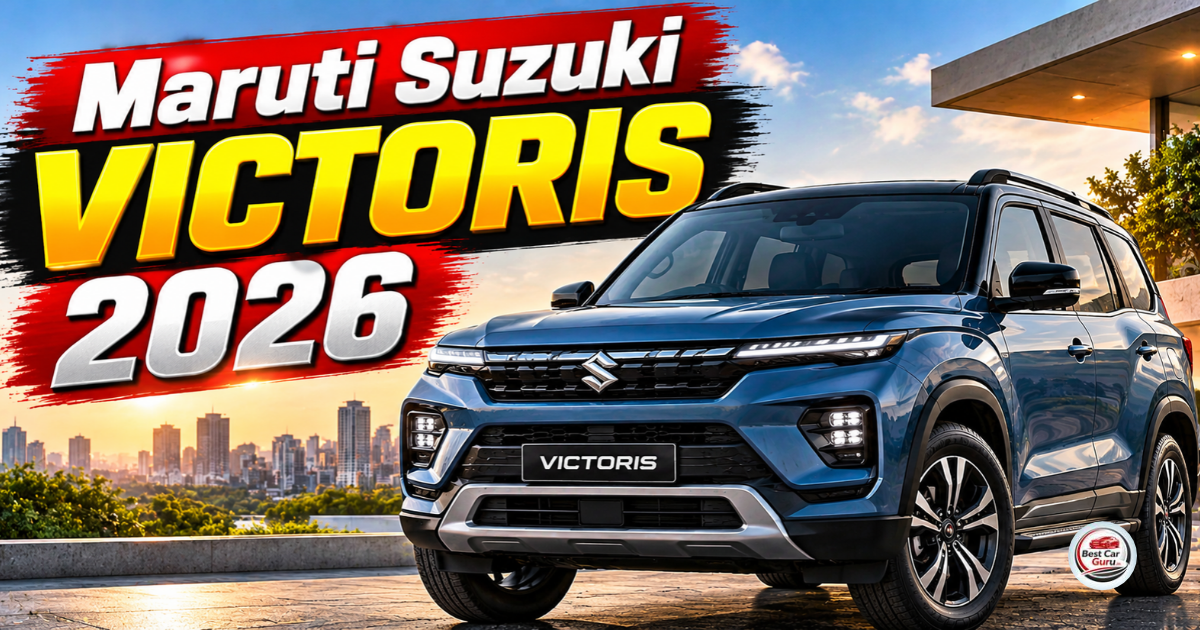
From the side, the Victoris reads like a grown-up Brezza, instantly recognisable as a Maruti Suzuki while carrying genuinely sharper, more modern design tweaks that give it a contemporary road presence. It uses conventional pull-type door handles rather than flush units, and the roofline towards the rear has a sloping character that hints at something larger than its actual footprint suggests. All variants ride on 17-inch alloy wheels with a design derived from the e Vitara’s rim styling, giving the Victoris a visual link to Maruti’s electric lineup despite being a conventional ICE and hybrid SUV.
The front fascia carries a confident, upright stance with sharp LED lighting elements, while the overall silhouette measures 4,360mm in length, 1,795mm in width, and 1,655mm in height on a 2,600mm wheelbase, dimensions that place it firmly in the mid-size SUV bracket alongside the Creta and Seltos. Ten paint shades are offered, including three genuinely striking dual-tone finishes like Eternal Blue with a contrasting roof, giving buyers more personalisation choice than is typical in this price segment.
Maruti Suzuki Victoris Interior, Cabin Space and Comfort Features
Step inside and this is unmistakably the most premium cabin Maruti has built to date. The dashboard gets a properly round, three-spoke steering wheel, a notable departure from the flat-bottom units and chrome roundel badging seen across most other Maruti models, paired with a new three-layered dashboard design and an available head-up display. A large 10.54-inch touchscreen infotainment system runs alongside a fully digital 10.25-inch instrument cluster, giving the cabin a genuinely modern, tech-forward feel.
Comfort features include ventilated front seats, an 8-way power-adjustable driver seat, 64-colour ambient lighting, a powered tailgate with gesture control, and a PM2.5 air filter with AQI display and auto-purify mode integrated directly into the infotainment screen. An 8-speaker Infinity Harman audio system with Dolby Atmos 5.1 surround sound delivers genuinely premium audio quality, while a 60W fast-charging dock with wireless charging and USB Type-C ports keeps devices powered throughout a journey. The honest trade-off, consistent across multiple reviews, is rear-seat width; shoulder room is tight for three adults across the back bench, and taller passengers may find rear headroom slightly limited due to the sloping roofline, a fair compromise given the design language Maruti chose to pursue.
Maruti Suzuki Victoris Engine Specifications, Performance and Transmission Options
The Victoris borrows its powertrain lineup from the Grand Vitara, giving buyers three genuinely distinct options depending on priorities around performance, efficiency, and running costs.
| Engine Option | Displacement | Power | Torque | Transmission | Claimed Mileage |
|---|---|---|---|---|---|
| Mild-Hybrid Petrol (NA) | 1.5L, 4-cyl | 101.6–103 PS | 137–139 Nm | 5-speed MT / 6-speed TC AT | 21.06–21.18 kmpl |
| Strong Hybrid | 1.5L Petrol + AC motor | 92.45–113.9 PS | 122–141 Nm | e-CVT | Up to 28.65 kmpl |
| S-CNG | 1.5L, 4-cyl | 87.8 PS | 121.5 Nm | 5-speed MT only | 27.02 km/kg |
| AllGrip AWD (Petrol) | 1.5L, 4-cyl | 101.6–103 PS | 137–139 Nm | 6-speed TC AT only | 19.07 kmpl |
The mild-hybrid petrol is the most popular configuration and offers genuinely smooth, comfortable everyday driving, with the 6-speed torque converter automatic delivering relaxed shift quality suited to both city and highway use. The strong hybrid setup is the standout for efficiency-focused buyers, combining the 1.5-litre petrol engine with an AC motor through an e-CVT for the kind of fuel economy figures rarely seen in a mid-size SUV. The AllGrip Select AWD system, available exclusively with the automatic transmission, gives the Victoris genuine versatility for buyers occasionally venturing onto rougher terrain, a feature few rivals in this exact price bracket offer at all. Real-world testing on the AWD mild-hybrid variant returned 14.78 kmpl in city driving and 20.24 kmpl on highways, figures that, while below ARAI claims as expected, remain genuinely competitive for an all-wheel-drive SUV of this size.
Also Read : Tata Sierra 2026 – The Legend is Back and Its Better Than Ever!
Maruti Suzuki Victoris Mileage and Real-World Fuel Efficiency
Fuel efficiency is genuinely one of the Victoris’s standout strengths across its entire powertrain lineup. ARAI-claimed figures peak at an impressive 28.65 km/l on the strong hybrid variant, making it one of the most fuel-efficient SUVs currently sold in India, while the CNG version claims 27.02 km/kg and the standard mild-hybrid petrol manages 21.06 to 21.18 kmpl depending on transmission choice. Even the AWD variant, typically the least efficient configuration in any SUV lineup due to added drivetrain complexity, still manages a respectable 19.07 kmpl.
Owners running mixed city and highway driving consistently report figures around 16 kmpl on standard petrol variants, broadly in line with expectations for a real-world mix of traffic and open-road conditions. A particularly clever engineering touch is the underbody CNG tank design, which frees up cabin and boot space that traditional boot-mounted CNG cylinders typically consume, making the CNG variant genuinely practical for daily family use rather than feeling like a compromised version of the petrol model.
Maruti Suzuki Victoris Safety Rating, ADAS and Bharat NCAP Score
Safety has become a genuine headline feature for the Victoris, addressing what was historically a common concern for buyers considering Maruti products over rivals. The Victoris earned a strong 5-star rating in Bharat NCAP crash testing, and six airbags come standard, paired with ABS, traction control, and a comprehensive electronic stability package built on the Suzuki TECT platform using high-strength steel construction.
Higher trims add a genuine Level 2 ADAS suite, a first for many Maruti buyers, alongside a 360-degree HD view camera that owners specifically praise as very useful in traffic and tight parking situations. Multiple owner reviews specifically cite the 5-star Bharat NCAP rating combined with six airbags as standard and automatic emergency braking as direct reasons they chose the Victoris over competing models, a meaningful shift in how Maruti’s safety reputation is now perceived in the market.
Maruti Suzuki Victoris Technology Features and Connected Car Tech
Beyond the dual digital displays, the Victoris brings genuinely segment-first technology to a Maruti product. The headline feature is Alexa Auto Voice AI, supporting more than 35 apps along with voice commands and connected device integration, a feature that elevates the in-cabin tech experience well beyond typical expectations for this price bracket. The Smartplay Pro X touchscreen infotainment system adds an extensive app store and personalisation options, while three distinct driving modes let drivers tailor throttle response to their preference.
An electronic parking brake with auto-hold, paddle shifters on automatic variants, and a head-up display on higher trims round off a tech package that genuinely feels like Maruti is competing directly with premium rivals rather than playing catch-up. Owner feedback consistently highlights the responsiveness of the infotainment system and the visual appeal of the full digital cluster, particularly at night, though a small number of reviews mention the music settings within the infotainment occasionally behaving erratically, a minor software quirk worth checking during a test drive.
Maruti Suzuki Victoris Price in India 2026 and Variants Explained
| Variant Tier | Powertrain Options Available | Ex-Showroom Price Range |
|---|---|---|
| LXi (base) | Mild-Hybrid Petrol | ₹10.49 Lakh – ₹10.50 Lakh |
| VXi / VXi (O) | Petrol, CNG | ₹11 Lakh – ₹12.1 Lakh range |
| ZXi / ZXi (O) | Petrol, Strong Hybrid, AWD | ₹14 Lakh – ₹17 Lakh range |
| ZXi+ / ZXi+ (O) (top) | Strong Hybrid, AWD Automatic | ₹17.5 Lakh – ₹19.99 Lakh |
The Victoris is offered across roughly 21 to 37 variants depending on how Maruti structures powertrain and feature combinations at any given time, giving buyers genuinely extensive flexibility to match engine choice, transmission, and feature level to their exact budget. It’s worth noting that as of October 2025, Maruti discontinued leatherette seat upholstery on the mid-spec ZXi and ZXi (O) variants while keeping prices unchanged, a small but relevant detail for buyers specifically shopping those trims. A modest price hike of up to ₹15,000 has also been applied to the top-spec ZXi+ (O) manual and automatic variants, while other trims remained unaffected.
Maruti Suzuki Victoris Real Owner Review and Driving Experience
Owner feedback on the Victoris has been overwhelmingly positive, with many specifically describing it as fulfilling the dream of owning a genuinely well-equipped SUV at an affordable price point. Multiple owners praise the smooth, comfortable driving experience, citing easy daily usability alongside genuinely impressive mileage figures, with several specifically calling out figures around 16 kmpl in mixed driving as better than expected for an SUV of this size. The buying and service experience has also drawn praise, with one owner specifically highlighting Maruti arranging pickup and drop-off for the first service as a meaningfully positive touch.
The most consistent, if minor, criticism across reviews points to rear-seat width for three adults and occasional quirks in the infotainment system’s music settings. A handful of owners also note that while the overall value proposition is strong, the top-spec variants edge closer to premium SUV pricing, leading some buyers to wish for roughly a lakh rupees of additional price reduction to make the value case even more compelling. None of these concerns appear to be denting demand meaningfully, given the car’s record-setting sales pace.
Also Read : Best SUV Under 15 Lakh in India 2026 – Complete Buyer’s Guide for Every Family
Maruti Suzuki Victoris Pros and Cons: Should You Buy It
| What Owners Love | What Owners Flag as a Concern |
|---|---|
| Indian Car of the Year 2026 winner with strong credibility | Rear shoulder room tight for three adults |
| 5-star Bharat NCAP rating with Level 2 ADAS | Taller passengers may find rear headroom limited |
| Best-in-class hybrid mileage up to 28.65 kmpl | Infotainment music settings occasionally erratic |
| AllGrip Select AWD option, rare in this price bracket | Top-spec variants edge toward premium pricing |
| Underbody CNG tank preserves boot and cabin space | Leatherette seats removed from mid-spec ZXi trims |
| Alexa Auto Voice AI and premium Harman audio system | New platform, long-term reliability still developing |
Maruti Suzuki Victoris vs Hyundai Creta vs Skoda Kushaq vs Maruti Grand Vitara Comparison
| Model | Starting Price | Top Mileage (Claimed) | AWD Available | Safety Rating |
|---|---|---|---|---|
| Maruti Victoris | ₹10.49 Lakh | 28.65 kmpl (Hybrid) | Yes, AllGrip Select | 5-star Bharat NCAP |
| Hyundai Creta | ₹10.79 Lakh | Approx 17–18 kmpl | No | 5-star Bharat NCAP |
| Skoda Kushaq | ₹11.6 Lakh approx | Approx 18–19 kmpl | No | 5-star Bharat NCAP |
| Maruti Grand Vitara | ₹11.4 Lakh | 28.65 kmpl (Hybrid) | No | 5-star Bharat NCAP |
The Victoris wins decisively on fuel efficiency across every powertrain option and stands out as one of the few mid-size SUVs in this price bracket offering genuine AWD capability. Where it sits closely matched against its own Grand Vitara sibling is largely on pricing strategy and dealership reach, with the Victoris pulling ahead specifically due to Arena network accessibility and sharper positioning. For buyers prioritising running costs, safety, and genuine all-weather capability over outright cabin width, the Victoris currently represents one of the strongest value propositions in its entire competitive set.
Maruti Suzuki Victoris Ownership Cost, Service and Resale Value
Running costs are competitive across the lineup, with five-year service costs estimated at approximately ₹7,214, benefiting from Maruti’s famously low-cost maintenance structure and the largest service network in the country. The strong hybrid and CNG variants further reduce running costs for high-mileage users, making the Victoris a genuinely compelling option for both private buyers and those covering significant daily distances.
Resale value is still an evolving picture given how recently the Victoris launched, but Maruti’s broader reputation for strong resale across its lineup, combined with the car’s record-setting sales pace and ICOTY 2026 recognition, suggests healthy demand that should translate into solid holding value as ownership data accumulates over the coming years. The car’s strong initial reception and rapid 1 lakh sales milestone are early indicators that point favourably toward sustained market confidence.
Who Should Buy the Maruti Suzuki Victoris: Final Verdict
If you want a genuinely well-equipped, fuel-efficient mid-size SUV backed by Maruti’s reliability and service network, with the added flexibility of AWD and multiple powertrain choices spanning petrol, hybrid, and CNG, the Victoris currently represents one of the smartest, most complete packages in its segment, and its award-winning reception and record sales pace reflect exactly that. If maximum rear-seat width for three adults or outright luxury cabin materials are your top priorities, it’s worth comparing closely against the Hyundai Creta or Skoda Kushaq, though neither matches the Victoris’s combined efficiency and AWD versatility at a similar price point.
Maruti Suzuki Victoris FAQ
What is the price of the Maruti Suzuki Victoris in 2026?
Ex-showroom prices range from ₹10.49 lakh to ₹19.99 lakh depending on the powertrain and variant chosen, with on-road prices in Delhi typically falling between ₹12.22 lakh and ₹23.14 lakh.
What is the mileage of the Maruti Suzuki Victoris?
The strong hybrid variant claims up to 28.65 kmpl, making it one of the most fuel-efficient SUVs in India, while the standard petrol manages 21.06 to 21.18 kmpl and CNG claims 27.02 km/kg.
Does the Maruti Suzuki Victoris have AWD?
Yes, it offers an AllGrip Select all-wheel-drive system, available exclusively with the automatic transmission, a genuinely rare feature in this price bracket.
Is the Maruti Suzuki Victoris safe?
Yes, it has earned a 5-star Bharat NCAP rating, with six airbags standard and a Level 2 ADAS suite available on higher trims, including automatic emergency braking.
Why did the Maruti Victoris win Indian Car of the Year 2026?
It earned the award for combining strong safety credentials, segment-first technology like Alexa Auto Voice AI, multiple powertrain options including AWD and hybrid, and Maruti’s extensive service network into one genuinely competitive, well-rounded package.