 by
by Hyundai Creta Electric : The Hyundai Creta has been India’s best-selling mid-size SUV for years, the kind of car you see in literally every neighbourhood, every parking lot, every used-car listing. So when Hyundai decided to give its golden goose an electric avatar, the industry paid attention, and so did buyers. The Creta Electric isn’t trying to reinvent the wheel with radical styling or gimmicky tech, it’s doing something arguably smarter: taking a nameplate that already has the trust of millions of Indian families and proving that going electric doesn’t mean giving up the familiarity, space, and reliability that made the Creta a household name in the first place.
This review covers everything you need before deciding: design, cabin experience, battery and range options, real driving performance, charging, safety, the full variant and pricing breakdown, genuine owner feedback, and how it measures up against the BE 6, e Vitara, and Curvv EV.
Hyundai Creta Electric 2026 Overview and Quick Specifications
| Parameter | Details |
|---|---|
| Segment | Mid-size Electric SUV |
| Price Range (Ex-showroom) | ₹18.02 Lakh – ₹24.70 Lakh |
| Battery Options | 42 kWh, 51.4 kWh (Long Range) |
| Power Output | Up to 171 PS (51.4kWh, 126kW motor) |
| Claimed Range (ARAI) | 420 km (42kWh) / 473–510 km (51.4kWh LR) |
| Real-World Range | 390–407 km depending on battery and driving |
| Drive Type | Front-Wheel Drive (single motor) |
| 0-100 km/h | 7.9 seconds |
| Charging (DC Fast, 50kW) | 10–80% in approximately 58 minutes |
| Top Speed | 160 km/h (electronically limited) |
| Safety Rating | 5-Star Bharat NCAP |
| Variants | 18 to 32 depending on configuration |
| Battery Warranty | 8 years / 1,60,000 km |
This table covers what most people search for first. Now let’s dig into why the Creta Electric has become such a significant talking point in India’s EV transition.
Why Hyundai Creta Electric Is Trending in 2026
The Creta Electric trends because it removes the single biggest psychological barrier to EV adoption in India: unfamiliarity. It looks almost identical to the petrol and diesel Creta that millions of Indians already trust, drive, and recommend to family members, with only subtle EV-specific cues like a closed-off grille, aero-optimized alloys, and a connected tail lamp setup giving away its electric nature. For a buyer nervous about making the jump to electric, that visual continuity matters enormously, it doesn’t feel like buying an experimental product, it feels like buying “the Creta, but electric.”
Layered on top of that familiarity is a genuinely competitive spec sheet. A claimed range up to 510 km on the Long Range battery, Level 2 ADAS with more than 20 features on higher trims, Vehicle-to-Load functionality for powering external devices, and Hyundai’s enormous, well-established service network combine to make the Creta Electric one of the lowest-perceived-risk EVs currently on sale in India. Add the brand’s track record for resale value, historically the strongest in the mid-size SUV category, and you get a car that’s trending not because it’s flashy, but because it’s reassuring.
Hyundai Creta Electric Exterior Design and Styling Highlights
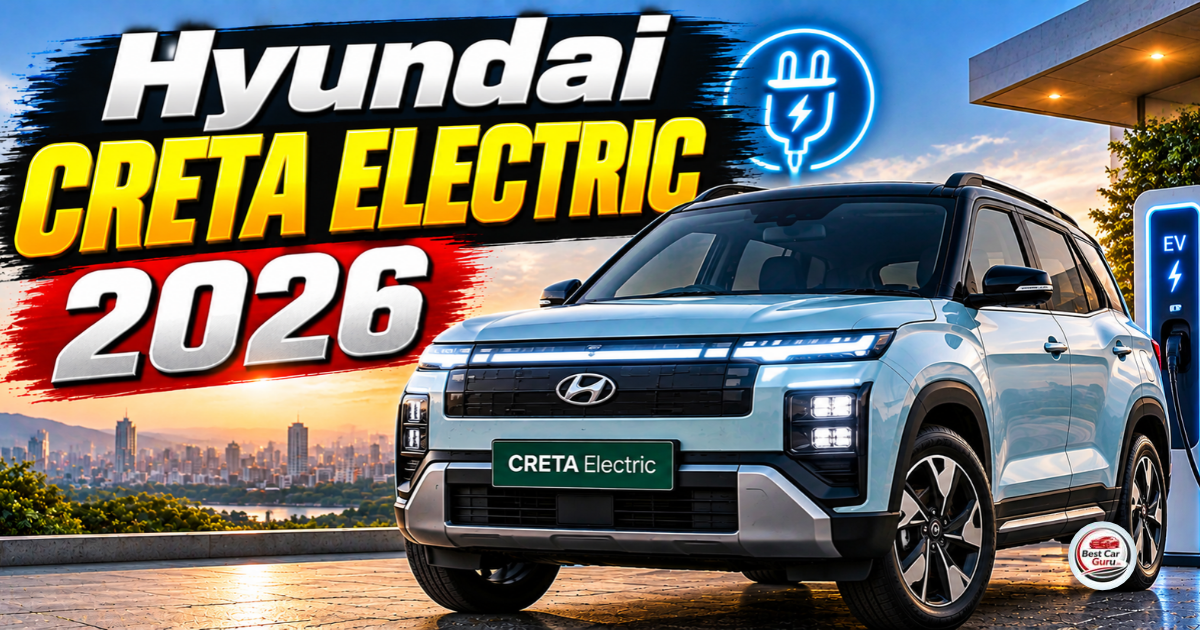
From a distance, this looks like a regular Creta, and that’s by design. Step closer and the differences become clear: a completely closed-off front grille improves aerodynamic efficiency, while an LED light bar stretches across the face for a distinctly modern, futuristic look without straying too far from the ICE model’s familiar proportions. Vertical headlamps and techy DRLs give the front end a confident stance, and Hyundai’s signature Morse-code “H” logo adds a subtle brand touch unique to the EV.
The side profile carries flat, EV-style alloy wheels, chiselled wheel arches, and the same recognisable C-pillar silhouette as the standard Creta, while the charging port is conveniently tucked at the front for easy nose-in parking at charging stations. At the rear, connected tail lamps, a black bumper insert, and a silver skid plate reinforce the SUV stance. A black-themed Knight Edition variant adds blacked-out exterior and interior accents for buyers wanting a more dramatic, statement-making look without changing the fundamental design language. New aero-optimized alloy wheels introduced for the 2026 model year specifically help squeeze out a few extra kilometres of real-world range.
Also Read : How Much Does Car Detailing Cost in 2026
Hyundai Creta Electric Interior, Cabin Space and Comfort Features
Inside, the Creta Electric feels like a premium lounge rather than a stripped-down EV. The dashboard carries dual 10.25-inch curvilinear screens shared with the ICE Creta but running an EV-specific user interface, paired with a three-spoke EV-specific steering wheel and a steering-column-mounted drive selector that frees up centre console space. A floating centre console with cooled storage, ambient lighting, and a mix of Type-A, Type-C, and wireless charging ports keeps devices powered on the go.
Electrically operated, ventilated front seats offer solid support for long drives, while the rear seats are genuinely spacious, with generous legroom, headroom, and enough width to seat three adults in adequate comfort, a meaningful advantage over rivals like the BE 6 that sacrifice rear space for styling. An “electric boss mode” lets rear passengers open up legroom by adjusting the front passenger seat remotely, and a rear seat tray with tablet and cup holders adds genuine road-trip practicality. A massive panoramic sunroof opens via voice control or buttons, flooding the cabin with light. The one consistent gripe across reviews is the heavy use of gloss-black interior trim, which attracts fingerprints and dust quickly, along with white seat upholstery on certain variants that shows dirt faster than darker alternatives.
Hyundai Creta Electric Battery, Motor and Performance Specifications
The Creta Electric is offered with two distinct battery and motor configurations, letting buyers choose between affordability and outright range.
| Battery Pack | Motor Power | Claimed Range (ARAI) | Real-World Range | 0-100 km/h |
|---|---|---|---|---|
| 42 kWh | Lower output motor | 420 km | Approx 390 km | Slightly slower |
| 51.4 kWh (Long Range) | 126 kW / approx 171 PS | 473–510 km | 400–407 km | 7.9 seconds |
On the road, the Creta Electric prioritises refinement and comfort over outright excitement, a deliberate calibration choice that suits its family-first positioning. Instant torque delivery makes every drive feel effortless in city traffic, with owners specifically praising how silent and composed the cabin feels even in heavy congestion. Three driving modes, Eco, Normal, and Sport, let drivers adjust throttle response and steering weight to match the situation, with Eco maximising range and Sport sharpening performance for highway overtaking. The ride leans toward soft and absorbent rather than sporty, which several reviewers note can feel slightly underdamped on broken roads at higher speeds, though it remains comfortable for the vast majority of everyday driving conditions. As of the 2026 model year, there’s no AWD or 4×4 option available, with the Creta Electric remaining strictly front-wheel-drive.
Hyundai Creta Electric Range, Charging and Real-World Efficiency
ARAI-claimed range tops out at 510 km on the 51.4kWh Long Range battery, though independent testing, including CarWale’s own range test, returned a more realistic figure of 407 km on a full charge, still a genuinely usable number for daily commuting plus occasional long trips. The 42kWh entry battery delivers a claimed 420 km, with real-world figures typically landing closer to 350 to 390 km depending on driving style, air conditioning use, and load.
Charging infrastructure covers both AC and DC options. A 50kW DC fast charger takes the battery from 10 to 80 percent in approximately 58 minutes, while an 11kW AC home charger is better suited to convenient overnight charging. Both the battery and motor carry an IP67 rating, meaning they’re protected against dust and water immersion, a genuinely reassuring detail for buyers concerned about monsoon waterlogging in Indian cities. Hyundai backs the battery pack with an 8-year or 1,60,000 km warranty, matching the industry’s strongest assurances on long-term degradation concerns.
Hyundai Creta Electric Safety Rating and ADAS Features
Safety is a clear strength of this electric SUV. Hyundai reinforced the chassis specifically for the EV version to protect the battery pack during side impacts, and the Creta Electric carries a full 5-star Bharat NCAP rating. Six airbags come standard across the range, alongside electronic stability control, hill descent control, all four-wheel disc brakes, and a rear camera even on the base Executive trim, ensuring a genuinely comprehensive safety baseline rather than reserving essentials for top variants only.
Higher trims, starting from the Excellence variant, add a Level 2 ADAS suite with more than 20 individual features, including adaptive cruise control, lane-keep assist, automatic emergency braking, and blind-spot monitoring. During real-world testing, lane-keep assist has been described as working smoothly without feeling overly intrusive, and forward collision warning has specifically been called out as effective in unpredictable Indian traffic conditions. A high-definition 360-degree camera is available on Excellence trims and above, making tight parking manoeuvres noticeably easier.
Hyundai Creta Electric Technology Features and Connected Car Tech
The dual 10.25-inch curvilinear screen setup is the cabin’s centrepiece, running an EV-specific interface distinct from the standard Creta’s software. Paddle shifters are repurposed for adjusting regenerative braking intensity rather than gear changes, letting drivers fine-tune how aggressively the car slows down when lifting off the accelerator. The Vehicle-to-Load feature, available from the Premium trim upward, lets owners power external appliances directly from the car’s battery, with a dedicated V2L connector gun available as a payable accessory for outdoor use.
An 8-speaker Bose sound system on Premium trims and above delivers genuinely strong audio quality, while a dashcam, surround view monitoring, and blind-spot view monitoring round off the tech package on Excellence trims. An 8-way powered driver’s seat with memory function is a particularly useful touch for households with multiple drivers who frequently switch between the same car.
Also Read : Petrol vs Diesel vs CNG vs Electric Car in India 2026 -Which is Best for YOU?
Hyundai Creta Electric Price in India 2026 and Variants Explained
| Variant Tier | Battery Option | Ex-Showroom Price Range |
|---|---|---|
| Executive | 42 kWh | ₹18.02 Lakh onwards |
| Executive Tech | 42 kWh | ₹19 Lakh onwards |
| Premium | 42 kWh | ₹20 Lakh onwards |
| Excellence | 42 kWh | ₹21.30 Lakh onwards |
| Excellence LR (Long Range) | 51.4 kWh | ₹23.67 Lakh – ₹24.70 Lakh |
The base Executive trim covers core safety essentials, including 6 airbags, electronic stability control, and hill descent control, while Executive Tech adds the voice-controlled panoramic sunroof, ventilated front seats, and wireless charging. Premium brings the Bose 8-speaker system, 10.25-inch navigation, V2L capability, and the 8-way electric driver seat, while Excellence is widely considered the value sweet spot, adding the full Level 2 ADAS suite, dashcam, and surround view without the roughly ₹2.37 lakh premium that the Excellence LR commands purely for the bigger battery and extended range. Unless long-distance driving is a regular requirement, the standard 42kWh Excellence trim genuinely covers most buyers’ needs without overspending on range they may rarely use.
Hyundai Creta Electric Real Owner Review and Driving Experience
Owner feedback is consistently strong on refinement and everyday usability. Multiple owners describe the buying experience as smooth and the driving feel as incredibly refined, silent, and comfortable, particularly in city traffic where instant torque makes every drive feel effortless. The spacious, well-crafted interior and modern design are repeatedly highlighted as making every trip feel premium, with several owners specifically praising the smooth ride rather than sporty character as perfectly suited to daily use rather than aggressive driving.
The most common practical criticism is the driver’s seat height; even at its lowest setting, some drivers find it sits higher than ideal, a quirk shared with the standard ICE Creta and worth checking personally during a test drive if seating position matters to you. The gloss-black interior trim’s tendency to show fingerprints and scratches quickly is another recurring, if minor, complaint, along with the visible battery bulge under the floor that slightly raises the cabin floor height compared to the standard Creta.
Hyundai Creta Electric Pros and Cons: Should You Buy It
| What Owners Love | What Owners Flag as a Concern |
|---|---|
| Familiar Creta design reduces EV adoption anxiety | No AWD or 4×4 option currently available |
| Spacious cabin comfortably seats three adults at the back | Driver’s seat sits high even at lowest setting |
| Strong real-world range of 390-407 km | Gloss-black trim attracts fingerprints and scratches easily |
| 5-star Bharat NCAP rating with comprehensive ADAS | Ride can feel slightly underdamped on broken roads |
| V2L functionality for powering external devices | Top-spec LR variant pricing edges into premium SUV territory |
| Hyundai’s extensive service network and strong resale reputation | Battery bulge slightly raises cabin floor height |
Hyundai Creta Electric vs Mahindra BE 6 vs Maruti e Vitara vs Tata Curvv EV Comparison
| Model | Starting Price | Claimed Range | Rear Seat Practicality | Safety Rating |
|---|---|---|---|---|
| Hyundai Creta Electric | ₹18.02 Lakh | Up to 510 km | Excellent, seats 3 adults comfortably | 5-star Bharat NCAP |
| Mahindra BE 6 | ₹18.90 Lakh | Up to 683 km | Limited, best for 2 passengers | 5-star Bharat NCAP |
| Maruti e Vitara | ₹15.99 Lakh | Up to 543 km | Good, but tighter headroom | 5-star Bharat NCAP |
| Tata Curvv EV | ₹17.49 Lakh approx | Up to 502 km | Moderate, coupe styling trims headroom | 5-star Bharat NCAP |
The Creta Electric leads decisively on rear-seat practicality and overall family usability, an area where the design-focused BE 6 and Curvv EV both make noticeable compromises. Where it concedes ground is outright range and performance, the BE 6 simply goes further and faster on paper, but for buyers prioritising space, brand trust, and a low-anxiety transition to electric motoring, the Creta Electric remains the most balanced, family-friendly choice in this comparison set.
Hyundai Creta Electric Ownership Cost, Service and Resale Value
Running costs follow standard EV economics, with electricity costs per kilometre significantly undercutting petrol or diesel equivalents, and the 8-year battery warranty providing genuine long-term reassurance. Hyundai’s existing dealer and service network, built over decades of ICE car sales, gives the Creta Electric a meaningful logistical advantage over newer EV-focused brands, since service appointments, spare parts, and trained technicians are far more widely available across Indian cities and towns.
Resale value is where the Creta Electric’s biggest long-term advantage likely lies. The standard Creta has historically commanded the strongest resale value in the mid-size SUV category in India, and while EV resale benchmarks are still developing nationally, Hyundai’s brand equity and the car’s broad market appeal position it well to carry that resale strength into the electric segment as ownership data accumulates over the coming years.
Who Should Buy the Hyundai Creta Electric: Final Verdict
If you’re a family buyer who wants to make the switch to electric without sacrificing space, comfort, or the peace of mind that comes from buying into an established, trusted nameplate, the Creta Electric is genuinely one of the safest, smartest choices in India’s EV market right now. If outright range, performance, or radical design excitement rank higher on your priority list than rear-seat comfort and everyday practicality, it’s worth cross-shopping the Mahindra BE 6 first, since it pushes further in those specific directions at a similar price point.
Hyundai Creta Electric FAQ
What is the price of the Hyundai Creta Electric in 2026?
Ex-showroom prices range from ₹18.02 lakh to ₹24.70 lakh depending on the battery option and variant chosen, with the Excellence trim widely considered the best value pick.
What is the real-world range of the Hyundai Creta Electric?
While ARAI claims up to 510 km on the 51.4kWh Long Range battery, independent testing typically shows around 400 to 407 km, still genuinely usable for daily commuting and occasional long trips.
Does the Hyundai Creta Electric have AWD?
No, as of the 2026 model year, it’s only available with a front-wheel-drive setup, with no official AWD or 4×4 variant currently offered in India.
How long does it take to charge the Creta Electric?
A 50kW DC fast charger takes the battery from 10 to 80 percent in approximately 58 minutes, while an 11kW AC home charger is better suited for convenient overnight charging.
Is the Hyundai Creta Electric good for families?
Yes, it’s specifically strong for families thanks to spacious rear seating that comfortably fits three adults, a 5-star Bharat NCAP safety rating, and a familiar driving experience that closely mirrors the trusted standard Creta.