 by
by You’ve probably seen those “50 must-have car accessories” listicles floating around the internet. Half of them are gadgets you’ll use exactly once before they disappear into your boot. The other half? Solving problems you didn’t even know you had.
Here’s what nobody tells you about the best car accessories for long trips: most of them aren’t fancy. They’re boring, practical, and they fix the small annoyances that turn a 12-hour drive from Mumbai to Goa into an exhausting ordeal. At Best Car Guru, we’ve spent years helping Indian car buyers make smarter decisions—not just about which car to buy, but how to actually use it for real-world travel. This isn’t theory. This is what works when you’re stuck in Pune-Satara Ghat traffic at 2 PM in May, or when you’ve been driving for six hours and your lower back feels like it’s going to snap.
Let’s clear up some myths.
Myth 1: A Good Phone Mount Is Good Enough for Navigation
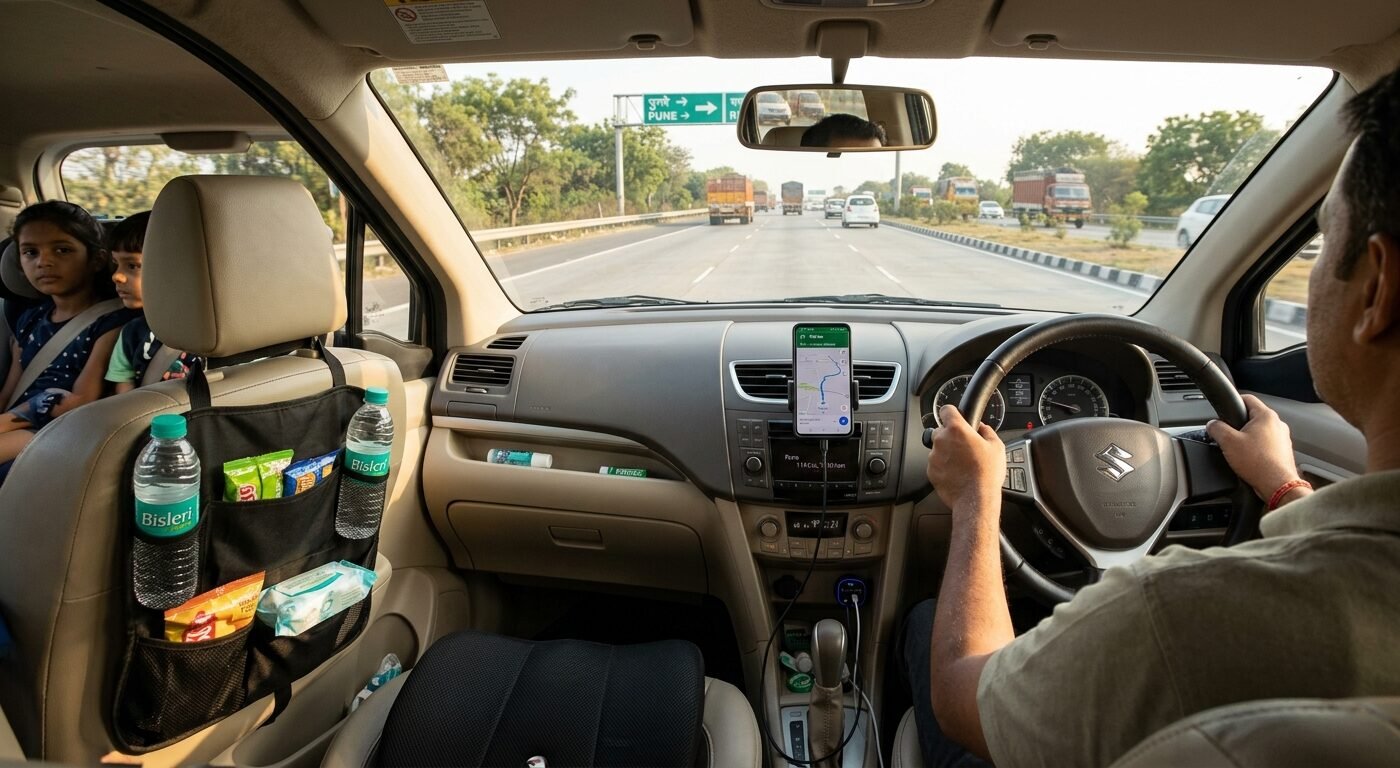
Most people think they’ve sorted navigation once they’ve bought that ₹300 phone holder from Amazon. Stick it on the dashboard, slot in your phone, done.
Wrong on three counts.
First, your phone overheats. Anyone who’s driven through Rajasthan in summer knows this. Direct sunlight plus constant GPS usage equals a phone that throttles itself or shuts down completely. Second, glare makes the screen unreadable half the time. Third—and this is the one that actually causes problems—you’re constantly glancing down, which is dangerous and tiring over long distances.
Here’s what works better: a dedicated GPS device or a dashboard camera with built-in navigation. Sounds old-school, doesn’t it? But these don’t overheat, they’re readable in direct sunlight, and most quality dashcams now record your route while navigating. We’ve seen families doing the Delhi-Shimla run who swear by this setup. Phone stays in your pocket, cooled down, charged up, ready when you actually need it—not drained to 12% by the time you reach your hotel.
And if you insist on using your phone? Get a vent-mounted holder, not a dashboard one. Keeps it cooler. Pair it with a small portable fan clipped to the same vent. Costs ₹200, saves your battery life.
Myth 2: Comfort Accessories Are Luxury Items You Can Skip
This one’s everywhere. “It’s just a few hours, I’ll manage.” Then hour four hits and your neck is stiff, your back hurts, and you’re irritable with everyone in the car.
Lumbar support cushions and neck pillows aren’t luxuries. They’re the difference between arriving tired and arriving wrecked. Most Indian cars—even the ones with “premium” interiors—have terrible lower back support for long drives. The Hyundai Creta’s seats are fine for city commutes, not for eight hours straight. Same with the Maruti Brezza.
A proper memory foam lumbar cushion changes everything. Not those thin ones filled with polyester that flatten after 20 minutes. The thick, firm ones that actually push your lower back into the correct position. Costs between ₹800 and ₹1,500. Buy once, use for years.
Same logic applies to seat gap fillers—those foam pieces that slot between your seat and centre console. Sounds pointless until your phone, keys, or toll receipt disappear into that gap for the fifth time and you’re fishing around while driving. Small annoyance, easy fix, worth the ₹400.
Here’s something nobody considers: a proper first aid kit. Not the dusty box that came with your car three years ago with two bandages and expired antiseptic. A real one with pain relief tablets, motion sickness medication, antacids, bandages that actually stick, and an emergency blanket. You’ll probably never need it. But the one time you do—maybe someone gets carsick on those Lonavala curves, maybe a kid scrapes their knee at a rest stop—you’ll be glad it’s there.
Myth 3: You Just Need One Good Charger and You’re Set
Everyone buys a dual-port USB charger and calls it done. Then reality kicks in. You’ve got two phones, maybe a tablet for the kids, a portable speaker, possibly a laptop, and if you’re using a dashcam, that’s eating a power port too. Suddenly two ports aren’t enough and someone’s device is always at 20%.
Here’s the setup that actually works: a three or four-port car charger with at least one USB-C port for fast charging, plus a power inverter if you’re carrying a laptop. The inverter plugs into your 12V socket and gives you a regular wall plug. Costs around ₹1,500 for a decent 150W model. Means you can charge anything, anytime.
But—and this matters—get a charger with individual port power output listed, not just total output. Some cheap chargers claim “4 ports, 5A total” but each port only delivers 1A. That’s useless for modern phones that need 2.4A or more to charge at a reasonable speed. Check the specs before buying.
And carry a proper cable organizer. Those velcro ties or cable clips that stick to your dashboard. Sounds trivial. It’s not. Tangled cables are annoying when you’re stationary. They’re genuinely distracting when you’re driving.
Myth 4: Storage Solutions Are Just About Boot Space
Most road trip packing guides obsess over roof carriers and boot organizers. Fair enough if you’re hauling camping gear. But for most families doing a week-long trip, the real storage problem isn’t in the boot. It’s inside the cabin.
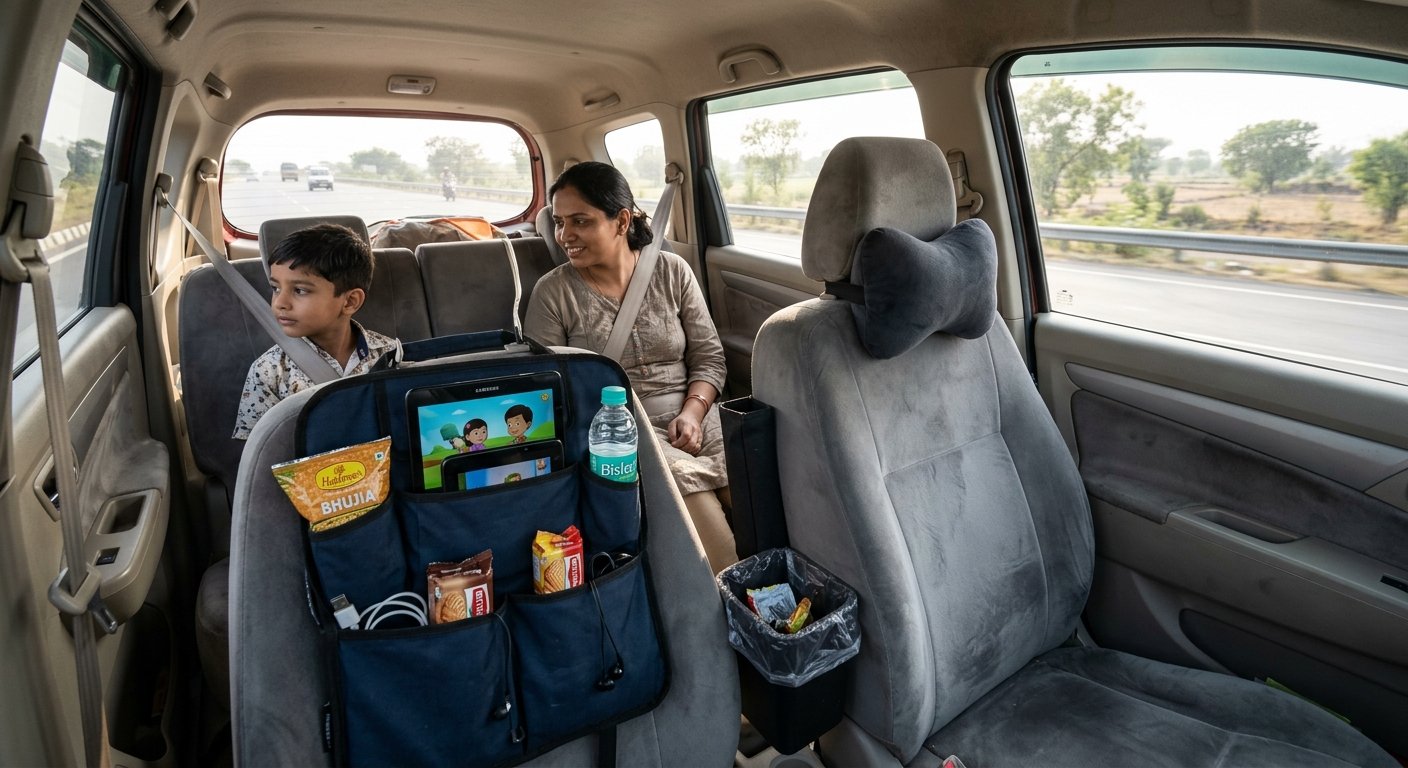
Where do the kids put their water bottles? Where does the front passenger keep their sunglasses, phone, snacks, and wallet without dumping everything on the dashboard or in the door pocket where it slides around every time you turn? Where do you put used tissues, wrappers, and all the small trash that accumulates during a 10-hour drive?
A good hanging backseat organizer solves half of this. The kind with multiple pockets—one for bottles, one for tablets, one for snacks. Costs ₹600 to ₹1,000. Keeps everything accessible without cluttering the front seats. We’ve recommended these to dozens of families at Best Car Guru, and the feedback is always the same: “Why didn’t we get this sooner?”
The other half? A small, lidded trash bin that sits in the footwell or hangs from the back of a seat. Sounds boring. It is boring. It’s also the difference between a clean car and a rolling dumpster by hour eight.
The Accessories Nobody Talks About But Everyone Eventually Needs
There’s a category of items that don’t fit neatly into myths or marketing. They’re just practical insurance against common problems.
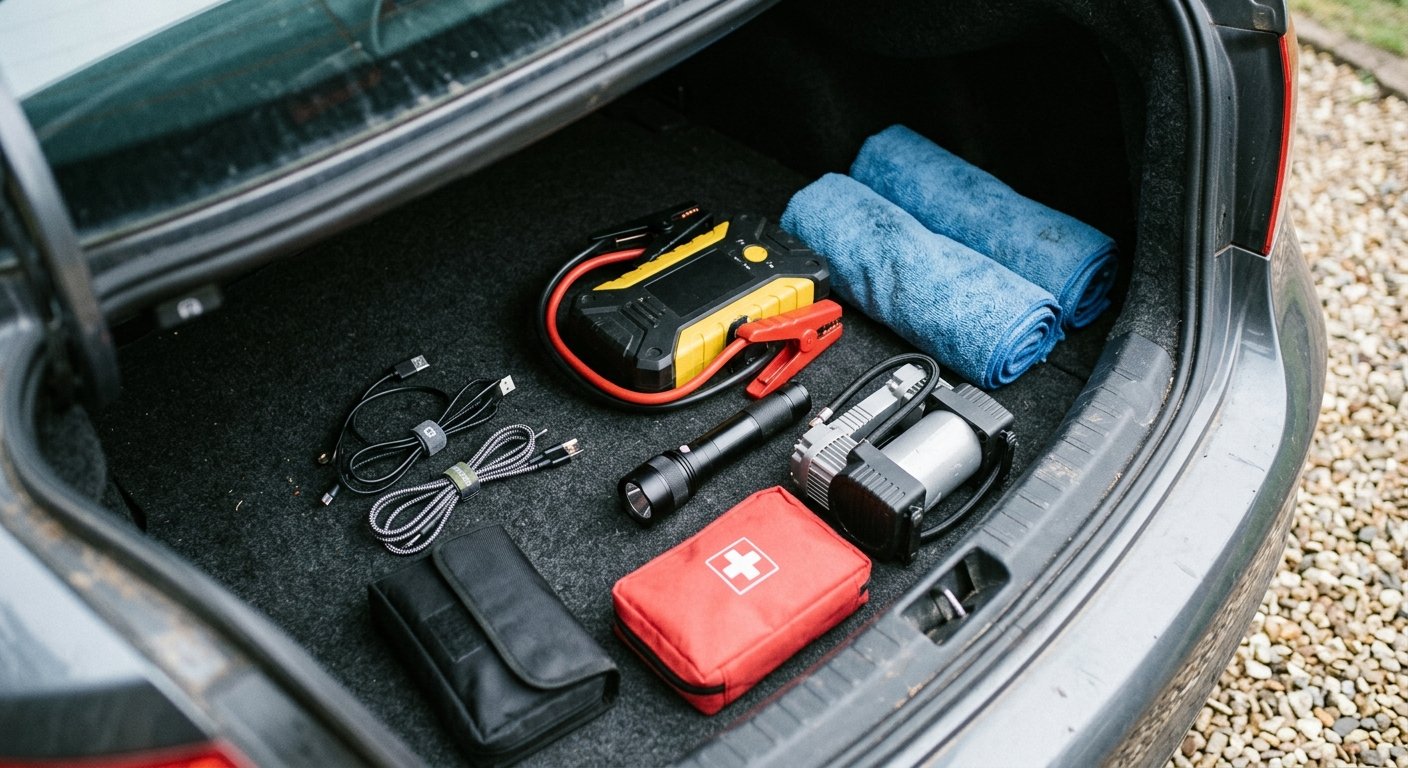
Jumper cables or a portable jump starter. Because batteries die, often at the worst times, and waiting for roadside assistance on the Jaipur-Bikaner highway isn’t fun. A basic jump starter costs ₹2,500. Use it once and it pays for itself.
A proper torch—not your phone’s flashlight. If you need to change a tyre at night, a phone torch held in your mouth while you’re crouched next to the wheel isn’t going to cut it. Get a rechargeable LED torch with a magnetic base. Sticks to your car’s body, lights up your workspace, leaves your hands free. Around ₹800.
Microfiber towels. Multiple. For cleaning your windshield when it fogs up, wiping down seats if someone spills something, drying your hands after refuelling. They compress small, dry fast, and work better than that one old rag you’ve had in your boot since 2023.
A portable tyre inflator. Most people rely on petrol pumps, which is fine until you’re on a rural highway at 9 PM and the nearest pump is 40 km away. A compact 12V inflator costs ₹1,500 to ₹2,500. Plugs into your car’s power socket, takes five minutes to top up a tyre. We’ve heard from Tata Nexon and Mahindra XUV owners who’ve used these multiple times on trips through less-developed routes—not for flats, just for slow leaks or pressure adjustments after highway driving.
What You Don’t Need Despite What the Internet Says
Let’s be honest about what doesn’t work.
Those fancy LED interior lights that change colour. Useless. Distracting at night, irrelevant during the day, and they drain power.
Steering wheel covers “for better grip.” If your steering wheel is so uncomfortable you need a cover, that’s a car problem, not an accessory solution. Most covers make steering feel mushy and less precise, which is the last thing you want on a long highway drive.
Neck pillows shaped like animals or cartoon characters. They look cute. They provide zero actual support. Get a proper ergonomic one or skip it entirely.
Overly complicated multi-tools that claim to do 17 things. They do all of them badly. A simple set of basic tools—screwdriver, pliers, knife—is more useful and easier to access in an emergency.
How to Actually Choose What You Need
Here’s the framework we use at Best Car Guru when helping people prepare for long drives: solve problems you’ve actually experienced, not problems you imagine you might have.
Think about your last long trip. What annoyed you? What made you uncomfortable? What did you wish you had? Start there. If your back hurt, buy lumbar support. If your phone died, upgrade your charging setup. If you couldn’t find anything in your car, add organizers.
Don’t buy 20 accessories before your first road trip just because some blog listed them. Buy three to five that address your specific car, your specific route, and your specific passengers. Test them on a short weekend trip. Add more based on what you learned.
And remember: the best car accessories aren’t the ones that look impressive in photos. They’re the boring, practical ones you forget are even there—until the moment you need them and they just work.
Frequently Asked Questions
What are the most essential car accessories for a long road trip in India?
Lumbar support cushion, multi-port fast charger, proper phone mount or GPS device, backseat organizer, portable jump starter, and a rechargeable torch. These solve the most common real-world problems on Indian highways—comfort, power, navigation, organization, and roadside emergencies.
Are expensive car accessories better than budget options for road trips?
Not always. Some categories like lumbar cushions and organizers work fine at ₹800 to ₹1,500. But for electronics—chargers, jump starters, dashcams—spending ₹2,000 to ₹3,000 on reliable brands prevents failures when you actually need them. Skip overpriced gadgets, invest in proven essentials.
How many charging ports do I really need in my car for long trips?
Minimum three, ideally four. Two for front passengers’ phones, one for backseat devices, one spare for dashcam or tablet. Make sure at least one port supports fast charging (2.4A or USB-C) and check individual port output, not just total charger capacity.
Do I need a dashcam for long road trips or is it unnecessary?
Not strictly necessary, but increasingly valuable. Modern dashcams with built-in GPS handle navigation, record your route for insurance purposes, and document any incidents. On highways with unpredictable traffic—especially rural routes—having video evidence protects you legally. Decent models start at ₹3,500.
What car accessories help prevent fatigue on drives longer than 8 hours?
Lumbar support cushion and neck pillow are non-negotiable for driver comfort. Add a dashcam or GPS for navigation so you’re not straining to read your phone. Keep a microfiber towel handy to clear windshield fog quickly. Small comfort fixes compound over long hours—your body will thank you by hour six.
Ready for Your Next Road Trip?
The right accessories don’t make road trips exciting. They make them less exhausting, less stressful, and significantly more comfortable—which is exactly what you want when you’re covering 800 kilometres in a day.
At Best Car Guru, we focus on what actually matters for Indian car owners. No fluff, no sponsored gadget lists, just honest recommendations based on real-world usage. Whether you’re planning your first long drive or your fiftieth, choosing the right vehicle accessories for trips makes every kilometre easier.
Need help deciding which car is best suited for long-distance travel, or want detailed comparisons of models based on comfort, mileage, and highway performance? Visit BestCarGuru.in for buying guides, ownership cost breakdowns, and practical advice that’s tailored specifically for Indian roads and budgets. Make smarter decisions. Drive better.