 by
by Kia Syros : Walk into any Kia showroom in India right now and there’s a good chance the salesperson steers the conversation toward the Syros within the first two minutes. It’s not hard to see why. Since its 2025 debut and the fresh 2026 update, the Syros has become one of the most talked-about subcompact SUVs in the country, not because it’s the cheapest or the most powerful, but because it dared to bring features usually reserved for cars costing double its price into the sub-4-meter and B2 segment. Sliding and reclining rear seats, a panoramic sunroof, and a 5-star Bharat NCAP rating in a package starting under ₹9 lakh, that combination simply hadn’t existed in this segment before.
This article breaks down everything that actually matters before you decide: design, cabin space, engine specs, real mileage, safety, pricing across the 2026 variant lineup, genuine owner feedback, and how it stacks up against rivals like the Hyundai Venue, Maruti Brezza, and Tata Nexon.
Kia Syros 2026 Overview and Quick Specifications
| Parameter | Details |
|---|---|
| Segment | Subcompact SUV (B2 segment) |
| Price Range (Ex-showroom) | ₹8.40 Lakh – ₹15.82 Lakh |
| Engine Options | 1.0L Turbo-Petrol, 1.5L Turbo-Diesel |
| Power Output | 118–120 bhp (petrol), 114–116 bhp (diesel) |
| Transmission | 6-speed MT, 7-speed DCT, 6-speed Torque Converter AT |
| Mileage (Claimed) | 17–20.75 kmpl |
| Seating Capacity | 5 |
| Boot Space | 390 litres |
| Ground Clearance | 189 mm |
| Safety Rating | 5-Star Bharat NCAP (Adult & Child) |
| Drive Type | Front-Wheel Drive |
| Dimensions (L x W x H) | 3,995mm x 1,805mm x 1,680mm |
| Wheelbase | 2,550mm |
This table covers what most buyers search for first. Now let’s get into why the Syros has built such a loyal, vocal fanbase in just over a year on Indian roads.
Why Kia Syros Is Trending in the Subcompact SUV Segment
The Syros occupies a strange but smart position: it sits between the Kia Sonet and the Seltos, offering more space and tech than the Sonet while costing meaningfully less than the Seltos. That positioning alone has made it a magnet for buyers who feel squeezed between “too small” and “too expensive” options elsewhere. Add to that a genuinely distinctive design borrowed from the boxy, EV9-inspired language Kia is pushing globally, and you get a car that looks nothing like its segment-mates.
The bigger trigger, though, is the feature list. Sliding and reclining second-row seats with ventilation are a first-in-segment innovation that no rival, not the Brezza, not the Venue, not even the pricier Creta, currently offers. Pair that with a panoramic sunroof, a 30-inch Trinity panoramic display spanning three screens, and an 8-speaker Harman Kardon sound system, and the Syros suddenly reads like a car punching well above its price bracket. The 2026 update sweetened the deal further by trimming the starting price to ₹8.40 lakh and adding four new variants, making the feature-rich trims more accessible than before.
Kia Syros Exterior Design and Styling Highlights
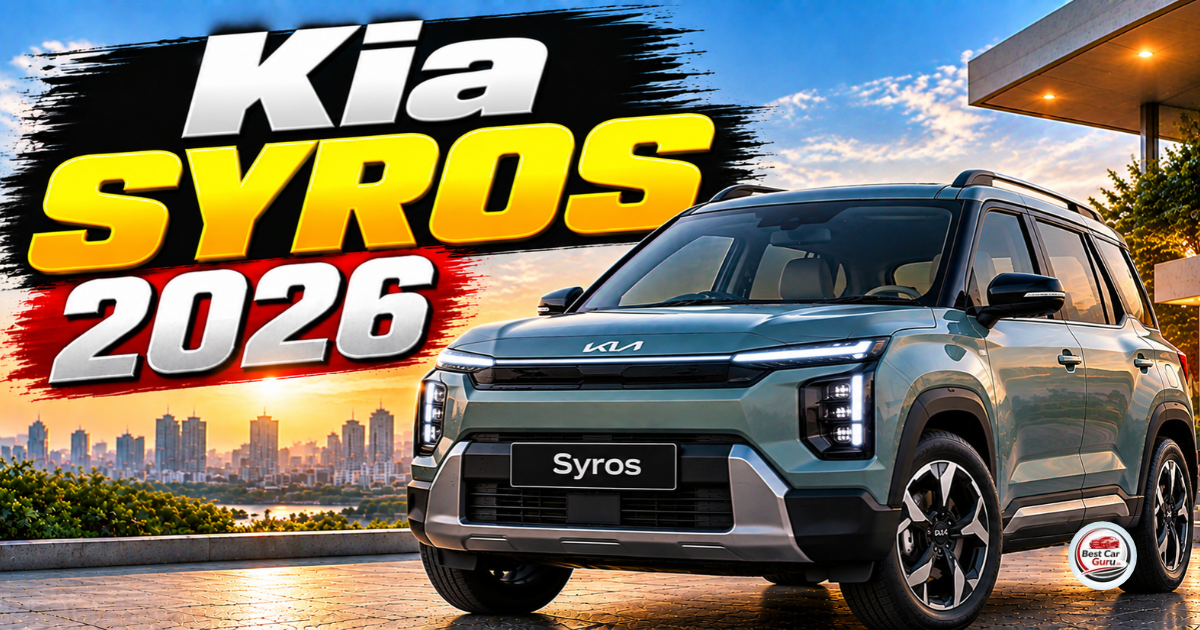
The Syros doesn’t try to blend in. Its tall-boy, upright stance with high squared shoulders and a chiselled bonnet gives it a presence that’s closer to a baby SUV-coupe than a traditional compact SUV. The front end carries futuristic LED headlamps with DRLs mounted low on the bumper, a styling choice some owners love and others find polarizing, paired with LED fog lamps and body-coloured aero inserts that were refreshed for the 2026 model year.
Side profile details include gloss black roof rails, body-coloured ORVMs, and on the top HTX and HTX(O) trims, new 17-inch dual-tone diamond-cut alloy wheels finished off with eye-catching neon green brake calipers. At the rear, a redesigned bumper, an LED high-mounted stop lamp, and a clean, almost vertical tailgate complete the boxy theme. At 3,995mm long, 1,805mm wide, and 1,680mm tall, the Syros is actually wider than most of its direct rivals including the Sonet, Venue, Brezza, and even the Nexon, which translates directly into the shoulder room you feel inside.
Kia Syros Interior, Cabin Space and Comfort Features
This is where the Syros genuinely separates itself from the pack. Step inside and the cabin tech mirrors what you’d find in much pricier Kia models like the Carnival or EV9, anchored by the 30-inch Trinity Panoramic Display that combines the instrument cluster, infotainment screen, and climate control panel into one continuous glass surface. The low-floor design and a genuinely spacious second row make entry and exit easy for elderly passengers, something families specifically call out in reviews.
The standout, first-in-segment feature is the second-row seat that slides, reclines, and gets a ventilated cushion, essentially bringing business-class comfort to a car costing under ₹16 lakh at the top end. Front seats also get ventilation on higher trims, along with height-adjustable seating and paddle shifters for added driver control. The 8-speaker Harman Kardon sound system and 64-colour ambient lighting round off a cabin that feels disproportionately premium for its segment, though it’s worth noting that the HTK Plus variant pairs the panoramic sunroof with the absence of auto AC or seat ventilation, a feature-distribution quirk that has drawn some criticism from buyers comparing trims closely.
Kia Syros Engine Specifications, Performance and Transmission Options
The Syros sticks to two well-proven engines, each offered with multiple transmission choices to suit different driving preferences.
| Engine Option | Displacement | Power | Torque | Transmission | Claimed Mileage |
|---|---|---|---|---|---|
| Smartstream G1.0 Turbo-Petrol | 1.0L, 3-cyl | 118–120 bhp | 172 Nm | 6-speed MT / 7-speed DCT | 18.2 kmpl |
| D1.5 CRDi VGT Turbo-Diesel | 1.5L, 4-cyl | 114–116 bhp | 250 Nm | 6-speed MT / 6-speed TC AT | 20.75 kmpl |
The turbo-petrol with the 7-speed DCT is the pick for buyers who want quick, confident city driving, with owners specifically praising how smooth and responsive the gearbox feels in daily use. That said, some reviewers note a slight lag in power delivery past 40 to 50 km/h on highways, which is worth experiencing on a test drive if you do a lot of highway overtaking. The diesel, meanwhile, is the segment’s torque champion at 250 Nm, and owners running it report real-world mileage in the 15 to 17 kmpl range in the city and up to 20 kmpl on the highway, figures that genuinely hold up against Kia’s ARAI claims better than most rivals manage. One area to watch is ride quality when fully loaded; the rear suspension can feel noticeably bouncier with two or three adult passengers seated at the back, something solo or two-person commuters won’t notice but families should test specifically.
Kia Syros Mileage and Real-World Fuel Efficiency
ARAI-claimed figures peak at 20.75 kmpl for the diesel manual, with the turbo-petrol rated at 18.2 kmpl. Real owners report a wider but still respectable spread: city mileage for the diesel typically lands between 15 and 17 kmpl, climbing to 20 kmpl on open highway stretches, while the petrol manages 11 to 12 kmpl in heavy city traffic and around 15 kmpl on highways. Several first-owners specifically mention that mileage improves noticeably after the first two or three services, suggesting an engine break-in period that’s worth factoring into expectations if you’re buying brand new. With a 45-litre fuel tank, the touring range is reasonable rather than class-leading, so long-distance road-trippers should plan fuel stops a touch more carefully than they would in, say, the Sierra or Creta.
Kia Syros Safety Rating, ADAS and Bharat NCAP Score
Safety remains one of the Syros’s strongest selling points, and Kia has been vocal about it being the first Kia model in India to earn 5-star Bharat NCAP ratings for both adult and child occupant protection. Standard equipment across the lineup includes 6 airbags, electronic stability control, all-wheel disc brakes, an electronic parking brake with auto-hold, a tyre pressure monitoring system, a rear-view camera, an inbuilt dashcam, and front and rear parking sensors, a genuinely comprehensive baseline safety package for this price segment.
There is one important caveat worth flagging clearly: as part of the 2026 model-year update, Kia removed the Level 2 ADAS suite and the 360-degree camera that were previously available on higher trims. Buyers specifically interested in adaptive cruise control, lane-keep assist, or automatic emergency braking should confirm current availability with their dealer before assuming the older feature list still applies, since this is a meaningful change from the original 2025 launch specification.
Also Read : Best SUV Under 15 Lakh in India 2026 – Complete Buyer’s Guide for Every Family
Kia Syros Technology Features and Connected Car Tech
The Syros runs on Kia Connect 2.0, packing more than 80 smart features that keep the car synced with your smartphone for remote functions, vehicle status checks, and alerts. The headline cabin feature remains the 30-inch Trinity Panoramic Display, combining a 12.3-inch touchscreen infotainment system with wireless Apple CarPlay and Android Auto, a 12.3-inch digital driver’s display, and a 5-inch automatic climate control screen into one seamless unit.
Audio duties are handled by an 8-speaker Harman Kardon system that consistently earns praise for clarity and depth that punches above the car’s price point. A dual-pane panoramic sunroof, wireless phone charging, and 64-colour ambient lighting round off a tech package that genuinely feels borrowed from a segment above, which is exactly the value proposition Kia has built the Syros’s entire marketing campaign around.
Kia Syros Price in India 2026 and Variants Explained
| Variant Tier | Engine Options Available | Ex-Showroom Price Range |
|---|---|---|
| HTE / HTE(O) (base) | 1.0L Turbo-Petrol | ₹8.40 Lakh onwards |
| HTK / HTK+ / HTK+(O) | Turbo-Petrol, Diesel | ₹9.4 Lakh – ₹12 Lakh range |
| HTX | Turbo-Petrol, Diesel, DCT/AT options | ₹12 Lakh – ₹14 Lakh range |
| HTX(O) (top) | Turbo-Petrol, Diesel Automatic | ₹15.82 Lakh – ₹18.8 Lakh |
The 2026 update specifically lowered the entry price while adding four new variants (HTE, HTE(O), HTK+(O), and HTX(O)) to make the feature-rich trims more accessible than the original 2025 lineup. On-road prices in Delhi range from roughly ₹10.20 lakh for the base petrol model to around ₹20.15 lakh for the fully loaded diesel automatic, once registration and insurance are added. It’s worth noting that the diesel automatic combination, available from the HTK Plus trim upward, became roughly ₹2.48 lakh more affordable with this update, making the Syros’s most desirable powertrain combination meaningfully easier to justify on a budget.
Kia Syros Real Owner Review and Driving Experience
Owner feedback on the Syros is consistently strong on comfort and cabin feel, with several long-term reviewers specifically highlighting how the second-row recline and slide function transforms long family drives. The diesel-automatic combination draws particular praise for smoothness under light loads and for delivering mileage figures close to or sometimes better than ARAI claims, especially on highway stretches. The boxy, EV-inspired design is genuinely polarizing; some owners call it “the most futuristic car in its price range,” while others admit it took time to grow on them.
On the flip side, the most consistent criticism across owner reviews is that the Syros isn’t an engaging driver’s car, it’s tuned firmly for comfort over sportiness, which is fine for most family buyers but worth knowing if you enjoy spirited driving. A handful of owners also mention minor ergonomic gaps, like a missing third rear headrest on certain trims, and occasional fuel gauge calibration quirks at low fill levels. None of these are dealbreakers, but they’re the kind of small, real-world details that only show up after a few thousand kilometres of ownership.
Kia Syros Pros and Cons: Should You Buy It
| What Owners Love | What Owners Flag as a Concern |
|---|---|
| First-in-segment sliding, reclining, ventilated rear seats | Level 2 ADAS and 360-degree camera removed in 2026 update |
| 5-star Bharat NCAP rating for adult and child safety | Not an engaging driver’s car, comfort-focused tuning |
| Panoramic sunroof and Trinity 3-screen display | Ride gets bouncier when fully loaded with passengers |
| Harman Kardon 8-speaker sound system | Starting price higher than Brezza, Venue and Sonet |
| Spacious, wide cabin for its segment | Mild turbo lag on the petrol past 40-50 km/h |
| Strong real-world diesel mileage | Feature distribution uneven across some mid trims |
Also Read : Best Cars Under 10 Lakh in India 2026 – Top Picks Across Every Category
Kia Syros vs Hyundai Venue vs Maruti Brezza vs Tata Nexon Comparison
| Model | Starting Price | Top Engine Power | Boot Space | Safety Rating |
|---|---|---|---|---|
| Kia Syros | ₹8.40 Lakh | 120 bhp turbo-petrol | 390 litres | 5-star Bharat NCAP |
| Hyundai Venue | ₹8 Lakh | 120 bhp turbo-petrol | 350 litres | 5-star Bharat NCAP |
| Maruti Brezza | ₹8.3 Lakh | 103 bhp petrol | 328 litres | 5-star Bharat NCAP |
| Tata Nexon | ₹8 Lakh | 118 bhp turbo-petrol | 350 litres | 5-star Bharat NCAP |
The Syros leads on cabin width, boot space, and outright feature richness, particularly the sliding-reclining rear seats that no rival here currently matches. Where it asks for a slight compromise is starting price, since it sits marginally above the Venue, Brezza, and Nexon at entry level, and the loss of ADAS on the 2026 update narrows its tech advantage over rivals that still offer driver-assist features at comparable price points. For buyers prioritising rear-seat comfort and outright presence, the Syros remains the segment’s most distinctive choice.
Kia Syros Ownership Cost, Service and Resale Value
Running costs sit in line with segment expectations, with the diesel proving slightly more economical to run per kilometre once you account for its stronger real-world mileage figures on highways. Kia’s service network has matured significantly in India over the past several years, and ownership reviews generally rate the brand’s after-sales experience as consistent, a point that compares favourably against some domestic rivals still building out their service reach. Resale value data is still developing given the car’s relatively recent launch, but Kia’s broader reputation for build quality and the Syros’s strong feature set are generally expected to support healthier resale numbers than entry-level rivals once the car has a few years of ownership history behind it.
Who Should Buy the Kia Syros: Final Verdict
If you’re a family buyer who values rear-seat comfort, cabin tech, and outright space over driving thrills, the Syros is currently one of the smartest choices in the subcompact SUV segment, and its first-in-segment seat features alone make it worth a test drive. If advanced driver-assist tech like ADAS is a non-negotiable requirement for you, it’s worth checking current-year variant specifications carefully, since the 2026 update scaled that feature back, and comparing against rivals that still offer it standard might better suit your priorities.
Kia Syros FAQ
What is the price of the Kia Syros in 2026?
Ex-showroom prices range from ₹8.40 lakh to ₹15.82 lakh, with on-road prices in Delhi falling between roughly ₹10.20 lakh and ₹20.15 lakh depending on the variant and engine chosen.
Does the Kia Syros come with ADAS?
The original 2025 launch offered a Level 2 ADAS suite on top trims, but Kia removed it along with the 360-degree camera as part of the 2026 model-year update, so it’s important to confirm current availability with your dealer.
Which engine offers better mileage, petrol or diesel?
The 1.5L turbo-diesel is the more efficient option with an ARAI-claimed 20.75 kmpl, and real-world owner reports of 15 to 20 kmpl, compared to the petrol’s claimed 18.2 kmpl.
What makes the Kia Syros different from rivals like the Venue or Brezza?
Its standout feature is the first-in-segment sliding, reclining, and ventilated second-row seat, paired with a panoramic sunroof and a 30-inch Trinity panoramic display, none of which its direct rivals currently offer.
Is the Kia Syros good for families?
Yes, it’s specifically engineered for family use with a low-floor design for easy entry, spacious second-row comfort, rear seat ventilation, and a full 5-star Bharat NCAP safety rating for both adults and children.
Image Generation Prompts
Thumbnail Image Prompt (Featured/Cover Image): “A modern Kia Syros SUV in Magma Red, parked on a clean Indian city street at sunset, three-quarter front angle showing the boxy, EV9-inspired silhouette and vertical LED headlamps, cinematic lighting, sharp details, automotive blog thumbnail style, 16:9 aspect ratio, text-free clean composition.”
Supporting Image 1 Prompt (Exterior/Design Section): “Close-up shot of the Kia Syros’s front fascia showing vertical LED headlamps, body-coloured aero inserts and 17-inch dual-tone alloy wheels with neon brake calipers, daylight, photorealistic automotive photography style, shallow depth of field, no text overlay.”
Supporting Image 2 Prompt (Interior/Tech Section): “Interior dashboard view of the Kia Syros showing the 30-inch Trinity Panoramic Display spanning instrument cluster, infotainment and climate control, second-row reclined seats visible in background, panoramic sunroof open above, soft natural light, photorealistic, no text overlay.”